Relativity by The Special & the General Theory(100thAnnED)Albert Einstein
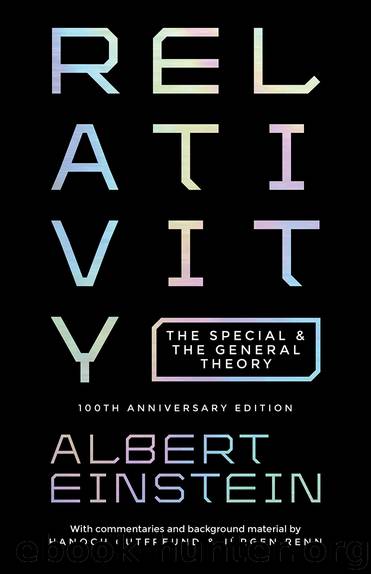
Author:The Special & the General Theory(100thAnnED)Albert Einstein
Language: eng
Format: epub
Publisher: Princeton University Press
Published: 2015-04-06T04:00:00+00:00
The Field
In Newtonian mechanics, space and time play a dual rôle. First, they play the part of carrier or frame for things that happen in physics, in reference to which events are described by the space co-ordinates and the time. In principle, matter is thought of as consisting of “material points,” the motions of which constitute physical happening. When matter is thought of as being continuous, this is done as it were provisionally in those cases where one does not wish to or cannot describe the discrete structure. In this case small parts (elements of volume) of the matter are treated similarly to material points, at least in so far as we are concerned merely with motions and not with occurrences which, at the moment, it is not possible or serves no useful purpose to attribute to motion (e.g. temperature changes, chemical processes). The second rôle of space and time was that of being an “inertial system.” From all conceivable systems of reference, inertial systems were considered to be advantageous in that, with respect to them, the law of inertia claimed validity.
In this, the essential thing is that “physical reality,” thought of as being independent of the subjects experiencing it, was conceived as consisting, at least in principle, of space and time on one hand, and of permanently existing material points, moving with respect to space and time, on the other. The idea of the independent existence of space and time can be expressed drastically in this way: If matter were to disappear, space and time alone would remain behind (as a kind of stage for physical happening).
The surmounting of this standpoint resulted from a development which, in the first place, appeared to have nothing to do with the problem of space-time, namely, the appearance of the concept of field and its final claim to replace, in principle, the idea of a particle (material point). In the framework of classical physics, the concept of field appeared as an auxiliary concept, in cases in which matter was treated as a continuum. For example, in the consideration of the heat conduction in a solid body, the state of the body is described by giving the temperature at every point of the body for every definite time. Mathematically, this means that the temperature T is represented as a mathematical expression (function) of the space co-ordinates and the time t (Temperature field). The law of heat conduction is represented as a local relation (differential equation), which embraces all special cases of the conduction of heat. The temperature is here a simple example of the concept of field. This is a quantity (or a complex of quantities), which is a function of the co-ordinates and the time. Another example is the description of the motion of a liquid. At every point there exists at any time a velocity, which is quantitatively described by its three “components” with respect to the axes of a co-ordinate system (vector). The components of the velocity at a point (field components), here also, are functions of the co-ordinates (x, y, z) and the time (t).
Download
This site does not store any files on its server. We only index and link to content provided by other sites. Please contact the content providers to delete copyright contents if any and email us, we'll remove relevant links or contents immediately.
Personalized inhaled bacteriophage therapy for treatment of multidrug-resistant Pseudomonas aeruginosa in cystic fibrosis by unknow(173442)
CONSORT 2025 statement: updated guideline for reporting randomized trials by unknow(81908)
Critical evaluation of the ProfiLER-02 study design and outcomes by Vivek Subbiah & Razelle Kurzrock(81472)
Cardiac gene therapy makes a comeback by Oliver J. Müller & Susanne Hille & Anca Kliesow Remes(81256)
Whisky: Malt Whiskies of Scotland (Collins Little Books) by dominic roskrow(74432)
Unveiling the design rules for tunable emission in graphene quantum dots: A high-throughput TDDFT and machine learning perspective by Şener Özönder & Mustafa Coşkun Özdemir & Caner Ünlü(50885)
A yeast-based oral therapeutic delivers immune checkpoint inhibitors to reduce intestinal tumor burden by unknow(40256)
Covalent hitchhikers guide proteins to the nucleus by Alexander F. Russell & Madeline F. Currie & Champak Chatterjee(40214)
Meet the Authors: Christopher R. Mansfield and Emily R. Derbyshire by Christopher R. Mansfield & Emily R. Derbyshire(40091)
Alkaline-earth metals promote propane dehydrogenation with carbon dioxide through geometric effects: Altering the reaction pathway by unknow(32728)
Induced iron vacancies boosting FeOOH loaded on sustainable Fenton-like collagen fiber membrane for efficient removal of emerging contaminants by unknow(32504)
Efficient electric-field-assisted photochemical conversion of methane to n-propanol exclusively over penetrated TiO2Ti hollow fibers by Guanghui Feng(32451)
Bi2SiO5 nanosheets as piezo-photocatalyst for efficient degradation of 2,4-Dichlorophenol by Hangyu Shi & Yifu Li & Lishan Zhang & Guoguan Liu & Qian Zhang & Xuan Ru & Shan Zhong(32382)
A novel NDIPTA organic heterojunction photocatalyst with built-in electric field for efficient hydrogen production by Jiahui Yang & Baojun Ma & Yongfa Zhu(32359)
Enhanced conversion of methane to liquid-phase oxygenates via hollow ferrite nanotube@horseradish peroxidase based photoenzymatic catalysis by Jun Duan & Shiying Fan & Xinyong Li & Shaomin Liu(32330)
Ordered macroporous superstructure of defective carbon adorned with tiny cobalt sulfide for selective electrocatalytic hydrogenation of cinnamaldehyde by Xiao-Shi Yuan & Sheng-Hua Zhou & San-Mei Wang & Wenbo Wei & Xiaofang Li & Xin-Tao Wu & Qi-Long Zhu(32256)
What's Done in Darkness by Kayla Perrin(27139)
Topological analysis of non-conjugated ethylene oxide cored dendrimers decorated with tetraphenylethylene: Insights from degree-based descriptors using the polynomial approach by A Theertha Nair & D Antony Xavier & Annmaria Baby & S Akhila(26518)
Investigation of mechanical and self-healing properties of hydroxyl-terminated polybutadiene functionalized with 2-ureido-4-pyrimidinone by Mohsen Kazazi & Mehran Hayaty & Ali Mousaviazar(26454)
